Yoga Grippy Socks: Traction & Comfort Reviewed

Table of Contents
- Why Yoga Grippy Socks Matter for Your Practice
- Non-Slip Yoga Socks: Grip Patterns and Traction
- Grip Socks for Pilates: Heel and Forefoot Support
- Open-Toe Grip Socks: Design, Fit, and Comfort
- Best Anti-Slip Socks for Exercise: Durability and Performance
- Barefoot Yoga vs. Grippy Socks: When to Choose Each
- Sizing, Fit, and Choosing the Right Pair
- Frequently Asked Questions
Last Updated: October 19, 2026
Why Yoga Grippy Socks Matter for Your Practice
Yoga grippy socks have become essential for anyone serious about their practice. Whether you're flowing through vinyasas or holding poses at home, stable footing is the difference between focusing on alignment and fighting for balance.
Here's what most guides miss: yoga grippy socks aren't just about preventing slides. They're about confidence.
At Original Pedi-Sox®, we invented the pedicure sock, and that same commitment to foot comfort drives everything we create. The open-toe design lets your toes breathe and spread naturally, and the grip pattern grips when it needs to while staying flexible when it shouldn't.
The real question isn't whether you need yoga grippy socks. It's which ones match your practice, your body, and your environment.
Non-Slip Yoga Socks: Grip Patterns and Traction
Non-slip yoga socks work through strategic grip placement. The sole contacts your mat or studio floor with precision, preventing sliding without restricting movement.
Grip patterns vary: some focus on the forefoot and heel, leaving the arch flexible, while others coat the entire sole for maximum stability. The choice depends on your practice style and floor type.
Full-Sole Coverage vs. Targeted Grip Dots
Full-sole coverage provides maximum stability across the entire foot, working best for practitioners who move frequently between poses, especially in barre or Pilates where lateral shifts happen constantly. The trade-off: less direct contact with the mat, which some find disconnects them from the ground.
Targeted grip dots concentrate traction at the heel and ball of the foot while the arch and midfoot stay flexible.
Stability on Studio Floors and Yoga Mats
Stability needs differ by surface. Yoga mats have grip built in, so your socks need enough traction to work with that surface without competing with it.
A pattern that grips perfectly on a mat might feel grabby on a studio floor, and a design built for wooden floors might slide on a newer, stickier mat.
Grip Socks for Pilates: Heel and Forefoot Support
Pilates demands different support than yoga, with smaller, more controlled movements. Grip socks for Pilates prioritize heel and forefoot stability because those are your contact points during reformer work and mat exercises.
Transitions matter more in Pilates than in yoga: your foot needs to grip, release, and reposition rapidly. A sock that's too sticky fights these transitions; one that's too light won't support your foundation.
Heel and forefoot support means reinforced grip in those zones: the ball of your foot handles most of your weight, and the heel anchors you during transitions and stretches. Original Pedi-Sox® Barefoot Sox™ designs address these pressure points with no-slip soles for secure footholds between heel and forefoot positions.
Open-Toe Grip Socks: Design, Fit, and Comfort
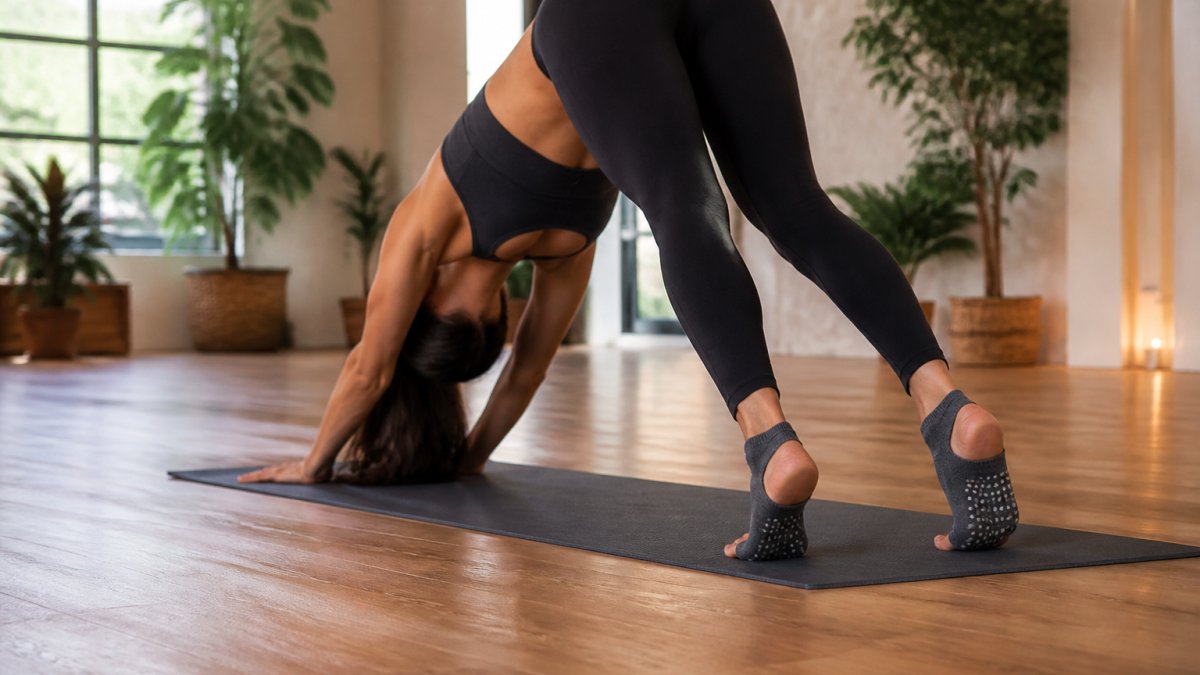
Open-toe grip socks solve a problem regular socks create: they let your toes breathe.
The open-toe design also allows natural toe spread, so your toes can splay and grip the mat independently. This enhances proprioception, and many practitioners report better balance and alignment when their toes have freedom to move.
Sock Length and Ankle Coverage Options
Sock length affects both comfort and aesthetics: ankle socks provide coverage and warmth, cropped crew socks sit below the ankle, and crew socks extend to mid-calf.
Ankle coverage matters most in cold environments, longer socks keep your feet warmer in a chilly studio or at home during winter. Shorter socks work better in heated studios, so year-round versatility means having options that match your climate and practice space.
Material Blends and Breathability
Material composition determines performance: acrylic-nylon blends offer breathability and stretch, cotton blends provide softness and moisture-wicking, and spandex adds elasticity so socks move with your foot, not against it.
Breathable materials let moisture escape before it builds up, keeping feet drier and socks fresher longer, especially during hot yoga or intense Pilates sessions.
Best Anti-Slip Socks for Exercise: Durability and Performance
Durability is the least-discussed and most decision-relevant attribute of anti-slip socks. The practical question isn't whether a sock has grip on day one, almost all do, but whether the grip pattern still functions after repeated washing, drying, and wear.
What Actually Wears Out First
Grip socks fail in a predictable order. The silicone or rubber grip elements degrade first, being the softest material and taking the most direct abrasion.
This order tells you what to inspect. A sock whose grip dots have flattened but whose knit still fits snugly can still serve for low-traction activities like restorative yoga or barre warm-ups.
How Grip Patterns Degrade
Silicone dots abrade from the top down: the raised profile flattens, and once the dots sit flush with the fabric, they stop gripping.
Grip typically feels strongest in the first few weeks, stabilizes for a long plateau, then drops off noticeably once the dots or coating reach a wear threshold. That cliff, rather than gradual decline, is why some people report socks "suddenly" becoming slippery.
Barefoot Sox™ - Yoga Socks & Dance - Happiness →
Washing Practices That Preserve Grip
The single biggest controllable factor in grip lifespan is heat. Hot water and high-heat machine drying accelerate breakdown of silicone and rubber grip elements and stress the knit's elastic fibers. Cold washing and air drying extend usable life more than any other habit.
Practical care steps that make a measurable difference:
- Turn socks inside out before washing so the grip surface is not abraded against other garments or the drum.
- Wash on a gentle cycle with like items; avoid zippers, hooks, and Velcro that can snag grip dots.
- Skip fabric softener and dryer sheets, which can leave a residue film on silicone that reduces tackiness.
A Simple Grip Test
You can assess remaining grip without special equipment. Dampen the sole slightly, place it on a clean mat or smooth floor, and press your foot down while attempting a slow lateral slide. Compare the resistance to a new pair. If the sock slides with little effort at the heel and ball, the grip has passed its useful threshold for dynamic practice, though it may still be fine for gentle or restorative sessions.
Realistic Lifespan Expectations
There is no universal wash-count guarantee, and any brand promising one is oversimplifying. A well-constructed sock used two to three times per week, washed cold, and air dried will hold usable grip noticeably longer than one washed hot and tumble dried, often the difference between replacing socks once a season versus every few months.
Barefoot Sox™ Product Lineup
Original Pedi-Sox® offers three Barefoot Sox™ styles, each designed for yoga, Pilates, barre, dance, and spa use.
Barefoot Sox™, Yoga Socks & Dance, Happiness ($9.00) comes in pink with warmer pink trim.
Barefoot Sox™, Yoga & Dance Socks, Energy ($9.00) features yellow with lime green trim.
Barefoot Sox™, Yoga Socks & Dance Socks, Midnight ($9.00) offers very dark gray with black trim.
| Barefoot Sox™ Style | Color | Material | Best For | Price |
|---|---|---|---|---|
| Happiness | Pink with pink trim | Acrylic-nylon blend | Practitioners who want vibrant color | $9.00 |
| Energy | Yellow with lime green trim | Acrylic-nylon blend | Bold, energetic practice styles | $9.00 |
| Midnight | Dark gray with black trim | Acrylic-nylon blend | Neutral, understated aesthetics | $9.00 |
Barefoot Yoga vs. Grippy Socks: When to Choose Each
Barefoot practice has merit. Direct contact with the mat enhances proprioception, and your nervous system receives clearer feedback about balance and alignment.
Grippy socks offer different advantages. They provide warmth and comfort, keep your feet clean on studio floors, and give you confidence on slippery surfaces.
The choice depends on your practice environment and personal needs. Heated studios with good traction mats? Barefoot often works well.
Sizing, Fit, and Choosing the Right Pair
Fit is where grip socks succeed or fail in practice. A sock with excellent traction that bunches under the arch or slides at the heel will feel slippery regardless of how good the grip pattern is. Because open-toe and heel-less designs, like the Barefoot Sox™ line, differ structurally from conventional socks, standard sock sizing intuition does not always transfer.
Why Grip Sock Fit Is Different
A conventional crew sock is anchored by a closed toe and a fitted heel pocket. An open-toe, heel-less sock has neither anchor. Instead, it relies on the knit's elasticity and the binding at the toe and heel openings to hold position.
As a result, two people with the same shoe size can need different grip sock sizes.
How to Measure at Home
You can get a reliable starting size with two measurements:
- Foot length: stand on a piece of paper, mark the tip of your longest toe and the back of your heel, and measure the distance.
- Ball circumference: wrap a soft tape measure around the widest part of your forefoot, just behind the toes.
Compare both to the brand's size chart rather than relying on shoe size alone. If you fall between sizes, size up for open-toe designs, the toe opening needs clearance so the binding does not press into your toes, and stay true-to-size for closed-toe grip socks, where a snugger fit keeps the grip pattern aligned.
Diagnosing Common Fit Problems
Most fit complaints map to a specific cause and a specific fix:
- Slipping at the heel: usually a sign the sock is too long or the heel opening is too loose. Try a smaller size, or a style with a more fitted heel opening.
- Bunching under the arch: often caused by excess length combined with a relaxed knit. Sizing down usually resolves it; if it persists, the sock's elastic has likely fatigued.
- Toe binding or pinching: common when an open-toe sock is sized too small. Size up so the toe opening sits cleanly behind the toes without pressing.
Fit Across Sock Styles
Different grip sock styles change how sizing feels:
- Open-toe, heel-less designs (like Barefoot Sox™) expose the toes and heel, so the fit is concentrated across the midfoot, snug across the instep, free at the ends.
- Closed-toe ankle socks anchor at the toe and heel, so standard sock sizing applies more directly.
- Crew and mid-calf styles add length and can feel tighter at the calf; if you are between sizes, consider the shorter option.
Trying Before You Commit
Before a full practice, do a two-minute fit check: stand and shift weight side to side, rise onto the balls of your feet, and move through a few poses that load the heel and forefoot. The sock should stay put without you adjusting it. If you find yourself tugging at the heel or smoothing the arch mid-flow, the size or style is wrong for your foot.
Frequently Asked Questions
Are yoga grippy socks actually necessary, or can I just do yoga barefoot?
Barefoot practice works for many yogis, but yoga grippy socks offer real advantages on studio floors and shared mats. They prevent slipping during transitions, reduce foot contact with studio surfaces, and provide stability in standing poses. For hot yoga or Pilates, where sweat increases slippage, grippy socks are especially useful. The choice depends on your comfort level, the studio environment, and whether you practice on your own mat or shared flooring.
How do you wash yoga grippy socks without damaging the grips?
Hand wash in cool water with mild soap, then air dry completely, avoid the dryer, which can damage the grip material. Machine washing on a gentle cycle is acceptable, but separate from other laundry to prevent snagging. Do not bleach or use fabric softener, as these degrade the silicone or rubber grip pattern. Proper care maintains grip performance through dozens of washes.
What's the difference between non-slip yoga socks and regular socks with grip?
Non-slip yoga socks feature specialized grip patterns designed specifically for studio floors and yoga mats, with silicone dots or full-sole coverage for maximum traction. Regular socks with grip lack this engineering and often slip during dynamic movement. Yoga grippy socks also feature breathable materials, snug fits, and open-toe or heel-less designs that allow natural foot movement during practice.
How should yoga grippy socks fit to stay in place during class?
Grippy socks should fit snugly without cutting off circulation. They should not bunch under your feet or slide during transitions. The sock should hug your arch and forefoot while allowing your toes to spread freely if the design is open-toe. A secure fit combined with a quality grip pattern keeps socks stable through standing poses, flows, and weight shifts.
- Editorial Team


Comments 0