
Socks to Wear After Applying Toenail Polish: A 2026 Guide

Table of Contents
- Socks to Wear After Applying Toenail Polish: The Short Answer
- When to Wear Socks After a Pedicure: A Polish-by-Polish Timeline
- What to Wear After a Pedicure While Polish Dries
- Open-Toe Socks for Pedicures: Why Toe-Less Beats Barefoot
- How to Prevent Smudging Toenail Polish: 7 Habits That Work
- Factors That Change Drying Time (And What Most Guides Skip)
- Conclusion: Pick the Right Socks and Protect Your Pedicure
- Frequently Asked Questions
Last Updated: October 14, 2026
Socks to Wear After Applying Toenail Polish: The Short Answer
The best socks to wear after applying toenail polish are toe-less socks that leave every painted nail completely uncovered. Toe-less socks warm your feet, protect your heels, and let polish dry without friction. If you wear regular closed-toe socks too soon, the fabric presses on wet lacquer and leaves smudges, dents, and lint marks. This guide from Original Pedi-Sox® explains exactly when to wear socks after a pedicure, what to wear while polish dries, and how to prevent smudging toenail polish for good.
Here is the short answer in one line: for regular polish, wait at least three hours before any fabric touches your toenails. For gel polish, the clock changes because curing, not air, sets the coating.
That three-hour window surprises people. Most of us assume polish is safe once it feels dry to the touch. It is not. A nail technician will tell you the same thing: the surface sets fast, but the layers underneath stay soft for hours.
Below, we break down a polish-by-polish timeline, what to wear in the meantime, and a step-by-step method for putting socks on safely when you truly cannot avoid them.
When to Wear Socks After a Pedicure: A Polish-by-Polish Timeline
When to wear socks after a pedicure depends on which polish is on your toes and on one distinction most guides skip: surface dryness is not the same as full cure. Surface dry means the top film no longer feels tacky. Full cure means the solvents have finished evaporating and the coating has hardened all the way through. Socks and shoes press on the whole film, not just the surface, so the full-cure clock is the one that matters.
Regular Polish: The Three-Hour Rule
Regular polish is air-dry lacquer, and it needs at least three hours before socks or closed shoes touch your toes. That three-hour mark is the safe minimum for fabric contact, not the finish line for durability. Regular lacquer keeps hardening for up to 24 hours as the remaining solvent works its way out, so treat the first day gently even after the three-hour window passes.
Thin coats dry faster than thick coats, and a top coat adds a protective barrier, but neither makes wet polish safe for fabric. A common pattern is that the base layers stay soft longest, which is why a nail that feels dry to the touch can still dent under a sock cuff.
Gel Polish and Curing: Why the Clock Changes
Gel polish is fully cured the moment the lamp cycle ends. The photoinitiators in the gel react to the UV or LED light and the coating hardens through its full thickness in one step, so you can put on socks or shoes right after your appointment with no smudging risk. There is no three-hour wait and no 24-hour hardening window.
The catch is removal, not drying. Gel lasts longer, but it also costs more and takes longer to take off, and repeated gel pedicures without a break can leave nails thin. If you get gel pedicures often, give your nails a rest between appointments.
Quick-Dry Products: Faster Surface, Same Cure
Quick-dry formulas and quick-dry top coats shorten the surface-dry time, sometimes to a few minutes. They do not shorten the full-cure time for regular lacquer. A quick-dry top coat can make polish feel set in 10 to 15 minutes, but the layers underneath still need the same hours to harden. Treat quick-dry products as a way to speed up the touch test, not as permission to pull on socks early.
Polish Type |
Dry To The Touch |
Safe for Socks |
Safe for Closed Shoes |
Fully Cured |
|---|---|---|---|---|
Regular polish |
30-60 minutes |
3 hours |
3+ hours |
Up to 24 hours |
Regular polish + quick-dry top coat |
10-15 minutes |
3 hours |
3+ hours |
Up to 24 hours |
Gel polish |
Immediately after curing |
Right away |
Right away |
Immediately after curing |
The practical takeaway: for regular polish, wait at least three hours before any fabric touches your toenails, and treat the first 24 hours as a gentle period. For gel polish, the clock changes because curing, not air, sets the coating.
What to Wear After a Pedicure While Polish Dries
What to wear after a pedicure comes down to one rule: nothing should touch the painted nails. Open-toed shoes and slides are the safest bet. When socks are unavoidable, toe-less socks solve the problem because they cover the foot but leave the toes bare.
Open-Toed Shoes and Slides: The Safest Bet
Open-toed shoes and slides are the safest choice while polish dries. They leave the nails exposed to air and keep fabric away from wet lacquer.
A few practical notes:
- Choose slides over flip-flops if you want less toe friction
- Avoid tight straps that press on fresh polish
- Skip closed-toe shoes entirely until the three-hour mark
- Keep a pair of slides by the door for pedicure days
Foot care professionals often suggest scheduling pedicures when you can head straight home. Fewer steps means fewer chances to bump a nail.
When Socks Are Unavoidable: The Step-by-Step Method
Sometimes socks are unavoidable. Cold weather, a yoga class, or a long commute can all force the issue. The fix is a careful method, not brute force.
- Wait as long as you possibly can, ideally the full three hours.
- Choose toe-less socks so the painted nails stay uncovered.
- Roll the sock fully down to the heel before it touches your foot.
- Slide your foot in slowly, keeping fabric away from the toes.
- Pull the sock up by the cuff, not the toe area.
- Press gently around the heel only, never across the nails.
- Check the polish before you stand up.
That last step matters. A quick check catches a smudge while you can still fix it.
Original Pedi-Sox® - Professional Blue Jean Denim →
Open-Toe Socks for Pedicures: Why Toe-Less Beats Barefoot
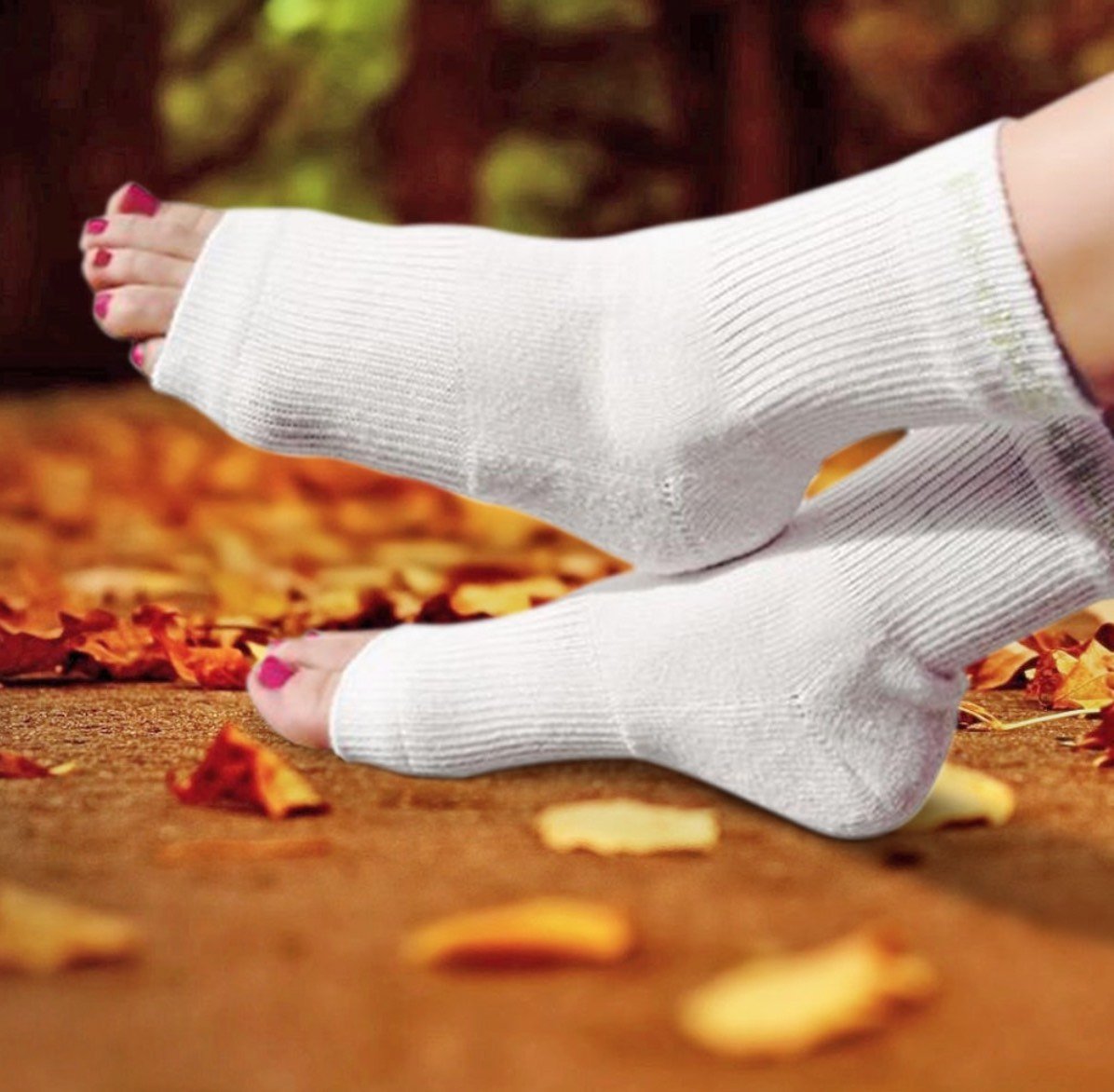
Open-toe socks for pedicures beat barefoot for one simple reason: they keep your feet warm and clean while polish dries untouched. The toe-less design covers the heel and sole but leaves all five nails exposed. Nothing presses on wet lacquer, so polish dries flawlessly.

Barefoot has real downsides. Cold feet make the whole pedicure appointment less relaxing. Bare feet also pick up dust and lint, which can stick to tacky polish.
This is where Original Pedi-Sox® comes in. We invented the pedicure sock, and our toe-less socks are built for exactly this moment. The stretchy acrylic and nylon blend stays put without bunching. You can wear them alone or with flip-flops, which makes them useful year-round. Nail technicians use them in salons every day, and they work just as well for at-home pedicures.
For most people, our top pick is the Original Pedi-Sox® SPA Lite at $8.00. It is a year-round weight with a heat-regulating acrylic and nylon blend. If you want something with a little more personality, the California Lite in Violet Belle ($8.00) or Mistress Black ($8.50) adds color without changing how the sock works.
How to Prevent Smudging Toenail Polish: 7 Habits That Work
To prevent smudging toenail polish, treat the first three hours like a no-touch zone. Most smudges come from small, avoidable contacts: a sock pulled on too fast, a shoe strap, a blanket. These seven habits cover nearly every case.
- Schedule pedicures for a slow day. Fewer errands means fewer bumps.
- Bring slides or open-toed shoes. Leave closed shoes at home.
- Ask for thin coats. Thin coats dry faster than thick coats.
- Say yes to a top coat. It adds a protective barrier over the color.
- Skip tight socks and tights. Friction and pressure cause dents.
- Keep feet still for the first hour. Let the base layers set.
- Use toe-less socks if you get cold. Warmth without contact.
What to Do After a Smudge or Dent
A smudge or dent is not the end of your pedicure. Small dents often smooth out on their own if you leave them alone. Do not press or rub the spot, because that spreads the damage.
For a real smudge, wait until the polish is fully dry, then lightly buff the area and add a thin coat of the same color. A drop of top coat over the repair seals it. If the smudge is deep, a quick salon touch-up is the cleanest fix.
Factors That Change Drying Time (And What Most Guides Skip)
Drying time is not fixed. Several factors speed it up or slow it down, and most guides skip them entirely.
- Humidity. Damp air slows evaporation, so polish stays soft longer.
- Temperature. Cold rooms slow the process; warm rooms speed it up.
- Coat thickness. Thick coats trap solvent underneath and stay tacky.
- Number of layers. Base coat, color, and top coat each add drying time.
- Airflow. A fan or open window helps more than most people expect.
- Polish formula. Quick-dry formulas set faster than standard lacquer.
- Nail texture. Smooth nails hold polish more evenly than ridged ones.
Here is the part that matters: a quick-dry top coat shortens the surface dry time, but it does not change the three-hour rule for socks. The layers underneath still need time.
Conclusion: Pick the Right Socks and Protect Your Pedicure
The right socks make a fresh pedicure last. Toe-less socks keep feet warm, protect the skin, and leave every painted nail untouched while it dries. That single change prevents most smudges, dents, and lint marks.
At Original Pedi-Sox®, we built our toe-less socks for exactly this job. They come in more than forty colors, styles, and material weights, so you can match the season and your mood. The stretchy fit stays in place during yoga, dance, and Pilates, and the open toes let polish dry flawlessly every time.
Ready to pamper your feet? Shop Original Pedi-Sox® toe-less socks and give your next pedicure the protection it deserves.
Frequently Asked Questions
When can I wear socks after nail polish?
For regular polish, wait at least three hours before pulling on socks. The surface may feel dry to the touch in 30 to 60 minutes, but the layers underneath are still soft and prone to smudging or denting. Gel polish that has been fully cured under a UV or LED lamp is hard immediately, so socks are safe right away. If you are unsure which type you have, three hours is the safe baseline.
Are open-toe socks a good choice after a pedicure?
Yes. Open-toe socks for pedicures, like Original Pedi-Sox® toe-less styles, cover the foot and ankle while leaving toes exposed, so nothing presses against fresh polish. They keep feet warm, protect skin from friction inside shoes, and let you walk around without risking a smudge. The SPA Lite option at $8.00 is a light, stretchy pick for year-round wear.
What should I do if my toenail polish smudges?
Do not try to wipe it. Let the smudge set for a few minutes, then use a small brush dipped in non-acetone remover to smooth the dented area only. If the damage is deep, apply one thin coat of the same color over the spot and let it dry fully. A quick-dry top coat over the repair helps seal it. Avoid walking on hard floors until the patch is dry to the touch.
How long should I wait before putting on closed-toe shoes after a pedicure?
Wait at least three hours after regular polish and until the polish is fully dry, not just dry to the touch. Even then, closed-toe shoes create pressure and friction that can dent soft layers. If you must wear them sooner, slip your feet in slowly, avoid wiggling your toes, and choose a roomy pair. Open-toed shoes or slides are the safer choice for the first few hours.
- Editorial Team


